
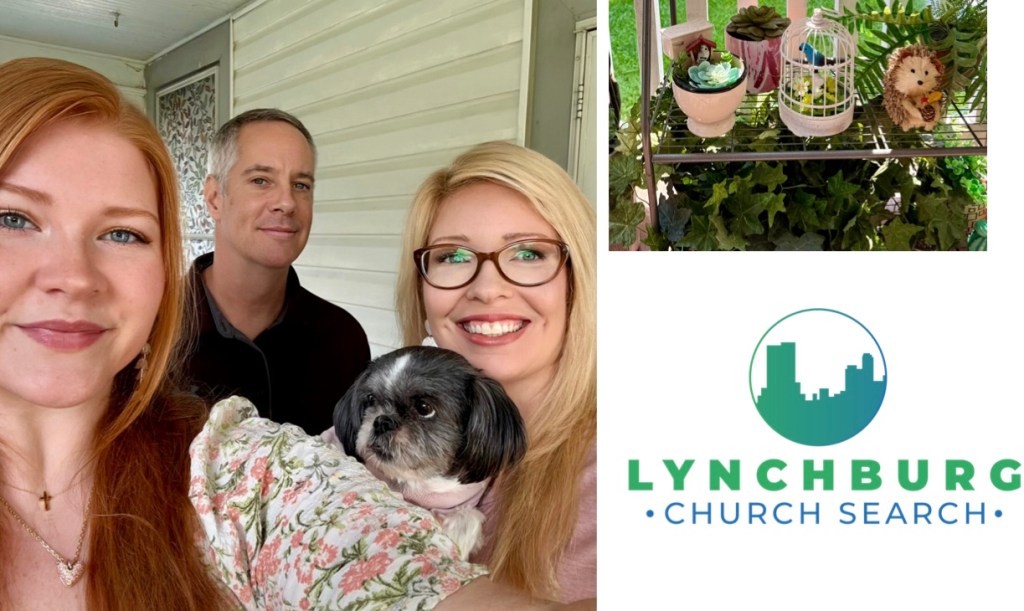
Casa De Lambert, Lynchburg VA
Church #174 was once again different this morning, and this week church happened at the Casa de Lambert.
We were all dressed, preparing to head out the door, and fully intending to attend an in-person service when our plans suddenly changed.
A few years ago, a change like that might have made me feel as though church had been missed, but this journey has taught me again and again that church does not disappear simply because our plans do. God is not waiting inside a particular building, wondering whether we will make it through the doors. He is already present wherever His people gather with hearts willing to listen, worship, learn, and love one another.
Instead of sitting in a pew, we gathered on the front porch, and I had the wonderful blessing of listening to my daughter preach a sermon to our hearts.
She compared the laws found in Leviticus to chocolate, and honestly, only my daughter could make Leviticus and chocolate belong in the same sermon so naturally. Yet the more she explained it, the more it made sense.
Chocolate can be sweet, bittersweet, rich, complicated, and sometimes so elaborate that we have to slow down to appreciate every layer. Leviticus can feel much the same way. There are parts that reveal the sweetness of belonging to God, parts that feel bitter because they show us the seriousness of sin, and parts so detailed that we may be tempted to never stop to ask why God cared enough to give His people such careful instruction.
Many of us reach Leviticus during our Bible reading and begin moving through it a little faster… and you know that is true, lol.
We understand the stories of creation, Noah, Abraham, Moses, and the Exodus, but then we arrive at laws about sacrifices, cleanliness, food, worship, priests, and daily living, and it can begin to feel a little long.
Yet hidden within all those instructions is something deep, God wanted to live among His people, and He was teaching them how to live as people who belonged to Him. These laws were not just some random rules handed down by a harsh God looking for reasons to punish someone. They were boundaries, reminders, protections, and invitations. They showed the people that their worship mattered, their choices mattered, the way they treated others mattered, and even the ordinary parts of their lives mattered to God.
That is where the comparison to chocolate became especially lovely to me. Some of the Bible is immediately sweet to us. We love verses about grace, mercy, restoration, and God working all things together for good. Those promises melt into our hearts easily because they comfort us. Other passages are more bittersweet because they confront us, correct us, and remind us that following God is not only about receiving what feels good. Sometimes God’s Word asks us to surrender something, change something, forgive someone, admit we were wrong, or obey when obedience is inconvenient. We may prefer the sweetness of His promises without the bitterness of correction, but both come from His love.
Real love does not only tell us what we want to hear. Real love guides us away from what can destroy us. A parent who loves a child creates boundaries because that child is precious. God was showing them He should be at the center of their relationships, their work, their meals, their treatment of the vulnerable, and the way they approached His presence.
Of course, we live under the new covenant through Jesus Christ. We are not made right with God by keeping the ceremonial laws of ancient Israel, and we do not offer animal sacrifices because Jesus became the final and perfect sacrifice for us. But Leviticus helps us understand the enormous cost of grace. It reminds us that sin is serious and the cross was everything. Every sacrifice in Leviticus pointed forward to the Lamb of God who would one day give His life for the world. The law showed humanity its need for a Savior, and Jesus became the fulfillment we could never accomplish on our own.
As I listened to my daughter speak, I was reminded that God can use anyone willing to share what He has placed on their heart. A sermon is not good because it is delivered from a stage beneath bright lights. Sometimes the message we most need comes from our own child while we sit together on a front porch. Sometimes the preacher is not wearing a suit or standing behind a pulpit. Sometimes she is sitting close enough that you can see the joy in her face while she explains how Leviticus is like chocolate.
That is one of the greatest joys this journey has given me. It has shown me that we truly are the church. The church is not simply a place we attend. It is who we become when we gather in the name of Jesus. On this particular Sunday, the sanctuary had porch railings. Our worship was accompanied by the sounds of the morning, and our ushers were the mosquitoes that showed up without being invited. Other than a few bites, it was such a peaceful and pleasant worship experience, and I highly recommend front porch church.
There was something so sweet about our togetherness. Life has been so heavy lately, and there have been many days when schedules, grief, work, responsibilities, and worry have pulled us in every possible direction. It can become easy to focus so much on what must be accomplished that we forget to be grateful for the people sitting right beside us. This morning, I found myself grateful simply to be together. I was grateful that when our original plans changed, God gave us something different instead of giving us nothing. I was grateful for the opportunity to hear my daughter share her heart, to laugh, to learn, and to worship exactly where we were.
God has met me in many unusual sanctuaries throughout this journey, and I have learned that He does some of His most personal work when our carefully organized plans fall apart. We often think a changed plan means something has gone wrong, but sometimes the interruption is the invitation. Perhaps God was not preventing us from having church that morning. Perhaps He was arranging the exact kind of church our hearts needed.
After my daughter finished her message, I shared another lesson that has been heavy on my heart, trusting God and letting go of ourselves. It is easy to say that we trust God. It is much harder to release our grip on the outcome. We can pray for God’s guidance and then spend the entire day trying to control every detail. We can ask Him to make a way and then panic because we cannot see how the way will be made. We can declare that we believe in miracles while constantly calculating whether a miracle is possible.
But are we really trusting God when we are relying only on ourselves?
Are we trusting Him for His promises, grace, wisdom, provision, and love when we refuse to release anything into His hands? Are we asking for His will to be done while quietly demanding that His will look exactly like ours?
That question is uncomfortable because I know how often I do it. I hand something to Jesus in prayer and then pick it back up before I even finish saying amen. I ask Him to lead me, but I still want a full explanation of where we are going. I ask Him to provide, but I want to know when, how, and through whom. I tell Him I surrender, but sometimes what I really mean is, “Lord, You may have this as long as You handle it the way I have already decided would be best.”
That is not surrender. That is trying to supervise God.
Trust requires us to admit that He knows what we do not know. His will may not always look like what we wanted, but His wisdom reaches far beyond what we can see. Sometimes the door we begged Him to open would have led us somewhere we were never meant to stay. Sometimes the delay we complained about was protecting us. Sometimes the answer that felt like rejection was actually redirection. Sometimes God changes the plan because He sees the entire road while we can only see the next few feet.
For God’s will to be done, we must also be willing to submit to that will, even when it is so much different from the future we imagined. Jesus showed us this in the Garden of Gethsemane when He prayed, “Not my will, but Yours be done.” He was surrendering Himself completely to the Father’s purpose.
Trust does not mean we never feel afraid. It means fear does not become our god. Trust does not mean we never worry. It means we keep returning the worry to the only one who can actually carry it.
We cannot experience the peace of surrender while continuing to hold every burden with closed fists. We cannot ask God to carry what we refuse to release. There comes a point when we must stop trying to be our own provider, protector, healer, and savior. We were never created to hold those positions. We can be responsible, work hard, plan wisely, and take the steps God places before us, but we cannot control everything that happens next.
That is where faith begins.
Faith begins where our control ends.
Maybe that is the lesson of both sermons we heard on the front porch. Leviticus teaches us that God is holy, His ways matter, and His people are called to live differently. Trust teaches us that we will never be able to accomplish anything like salvation or even this life through our own strength. We need grace. We need wisdom. We need boundaries. We need Jesus.
And perhaps that is the bittersweet chocolate of faith. The bitter truth is that we are not in control. The sweetness is that God is.
We ended our front porch worship service by listening to “No Longer Bound” by Forrest Frank, a peppy selection chosen by my daughter, of course. It was the perfect ending because Jesus did not come merely to make our lives more manageable. He came to set us free. Free from sin, free from shame, free from believing we must earn His love, and free from the exhausting belief that everything depends on us.
I do not have to know exactly what next week will bring. I do not have to understand every change in plans. I do not have to carry tomorrow before it arrives. I can trust God who met us on the front porch this morning will meet us wherever we are led next.
Thank you for continuing to follow along through every unexpected turn, every mountaintop, every valley, every online service, every unusual sanctuary, and every changed plan. It has now been over three years, and through everything, God has continued to show me that He is good. His goodness has never depended on a building, a schedule, or life going exactly as expected.
Sometimes church happens when we make it through the doors.
Sometimes church happens because we never do.
This week, the plans changed, the porch became the sanctuary, my daughter became the preacher, Leviticus became chocolate, mosquitoes became the congregation we did not ask for, and God met us right where we were.
I cannot wait to see where the Holy Spirit leads next week.
Love you all,
Annie Stewart Lambert
 Lynchburg Church Search